
Developed to help bond market participants better understand trading trends in the fixed income markets, BondWave’s Data Lab has released its QMarksTM dashboards for the third quarter of 2026.
QMarks is a proprietary BondWave data set that powers its quarterly dashboards to cover all disseminated bond transactions using the regulatory-prescribed Prevailing Market Price methodology for corporate, municipal, agency, and 144A. QMarks belongs to a suite of other BondWave proprietary data sets, including QCurves, QTrades, and QScores.
To keep our QMarks Dashboards up to date and informative, we are doing something a little different. We will begin rotating panels each quarter to showcase new information that highlights various elements of the fixed income market.
This quarter, we will conclude our focus on outliers with an examination of overall trends. In addition to the brief examination the dashboards provide we will follow up with a more in-depth analysis of outliers amid the recent bout of market volatility.
Finally, in Q4, we will examine the role of slippage in fixed income trading.
Q3 2026 Observations:
Corporate Bond Market Trends
Source: BondWave QMarks
-
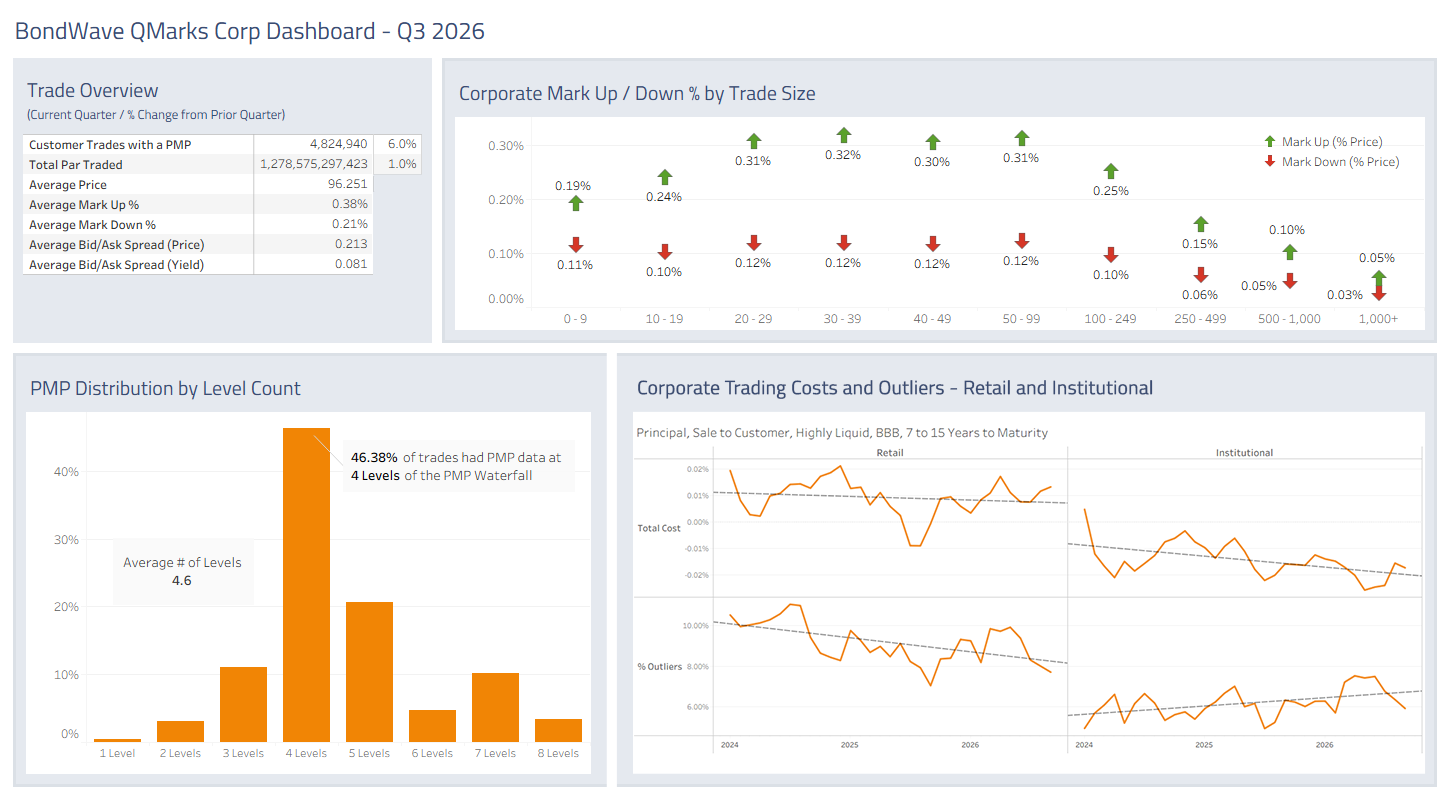
Corporate trade volumes grew slightly in the third quarter.
-
Trade counts increased 6% while par traded only grew 1% in Q3.
- Outliers
- In focusing on overall trends, we looked at the most liquid end of the corporate market – sales to customers in liquid, BBB rated, 7 to15 year bonds, executed as principal.
- In spite of recent heightened volatility, retail sized orders have seen a decrease in the percentage of trades that could be considered outliers.
- The decrease in outliers is a longer-term trend in retail trading.
- While institutional sized trades also defied the uptick in volatility to post fewer outlier trades, the long-term trend is still slightly positive.
- The long-term trend in trading cost is lower for all trade sizes even as there has been an uptick in the past two quarters.
144A Bond Market Trends
Source: BondWave QMarks
-
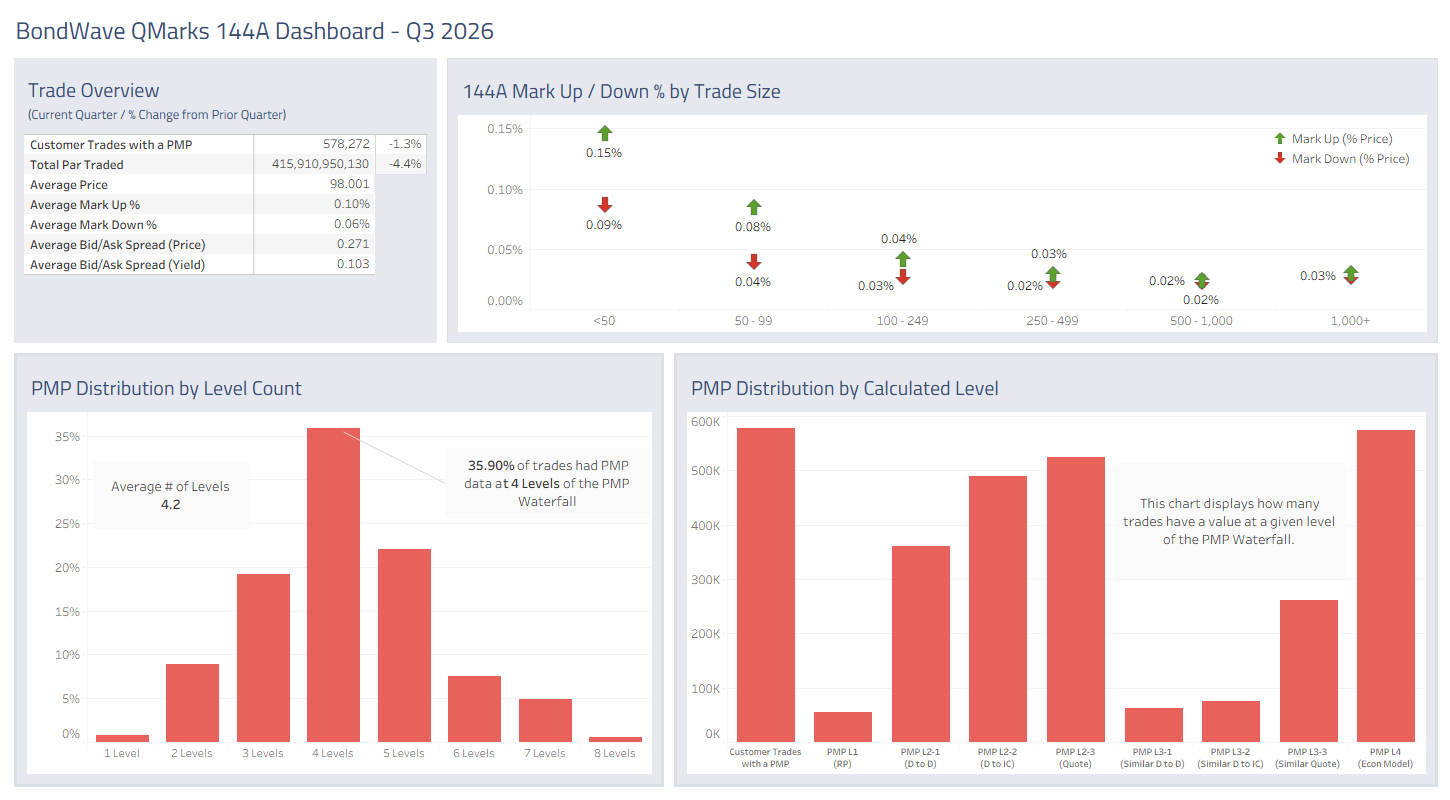
144A volumes were slightly lower in the third quarter.
-
Trade counts were off 1.3% prior to Q2.
-
Par traded was down 4.4%.
Municipal Bond Market Trends
Source: BondWave QMarks
-
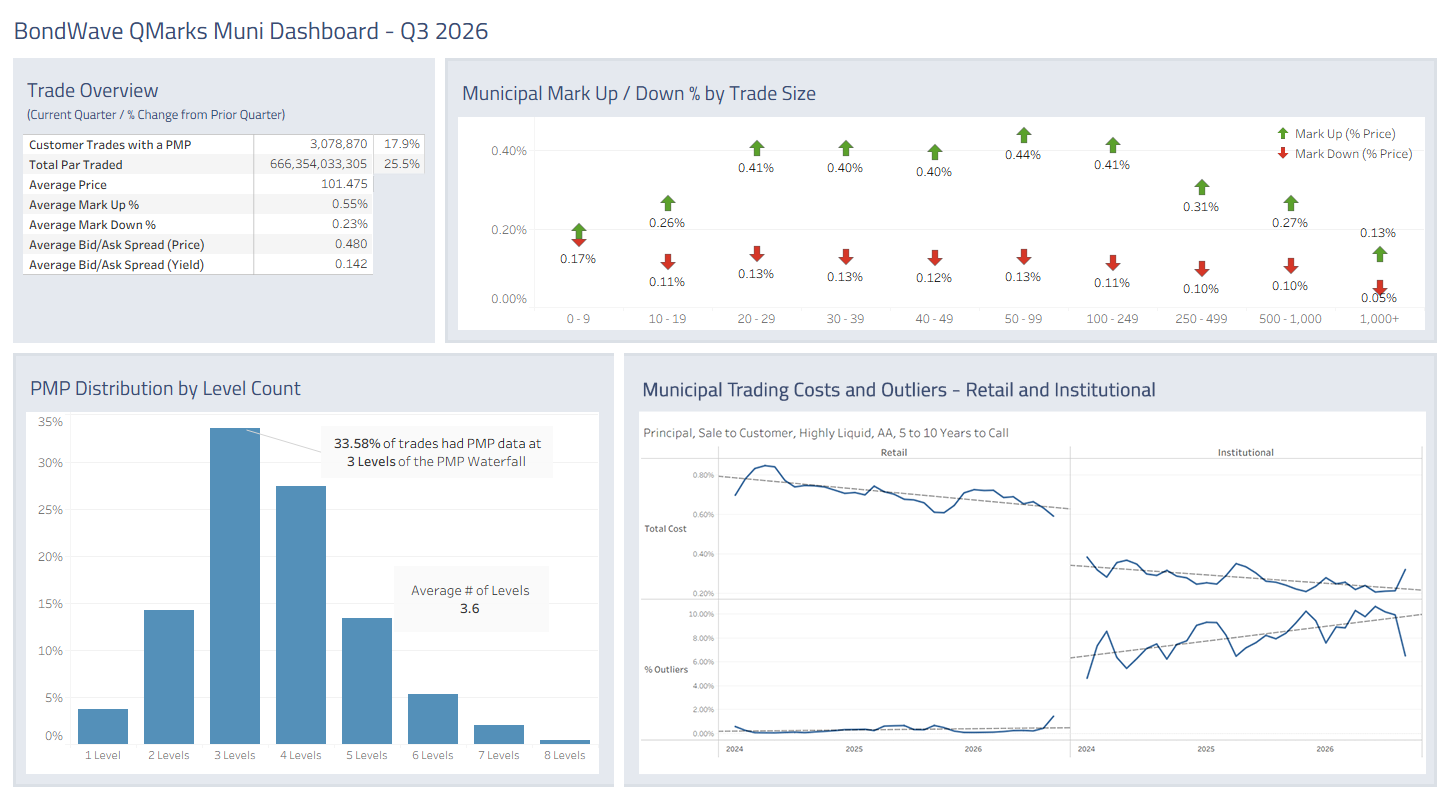
In focusing on overall trends, we looked at the most liquid end of the municipal market – sales to customers in liquid, AA rated bonds with 5 to 10 years to next call, executed as principal.
-
Municipal trading continued its strong run from Q2 to Q3.
-
Trade counts grew 17.9% and par traded grew 25.5%.
- Outliers
-
Outlier executions in the retail space are not a major consideration.
-
While Q3 saw the largest share of outlier trades in the last 7 quarters, it still only clocked in at 1.4% of trades.
-
Institutional size trades saw a sharp decline in the third quarter to buck their long-term upward trend.
-
This is against a backdrop of generally lower trading costs since the beginning of 2024 for all trade sizes.
-
Agency Bond Market Trends
Source: BondWave QMarks
-
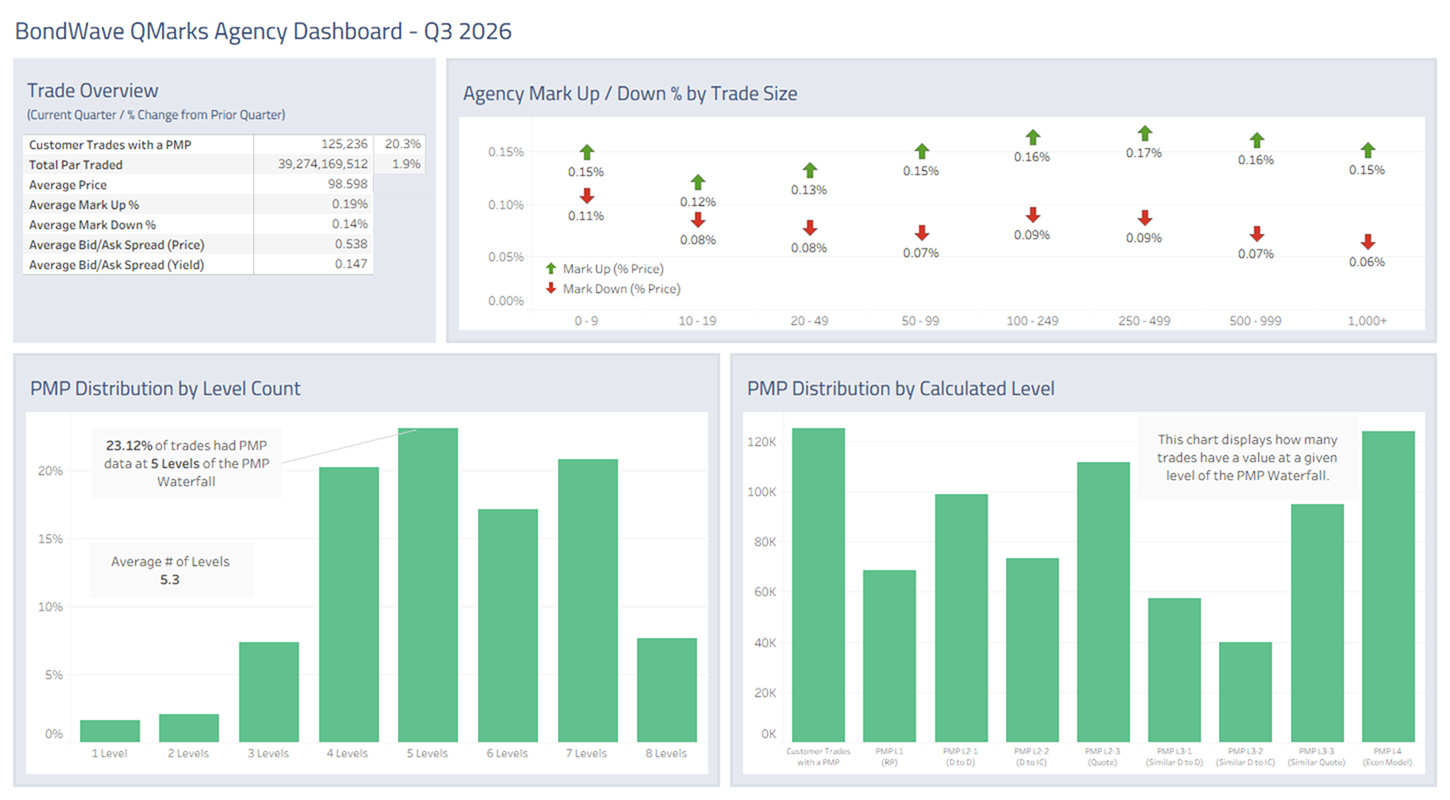
Agency volumes recovered some of their Q2 decreases.
-
Trade counts recovered 20.3% in Q3 after slumping 26.7% in Q2.
-
However, par traded only bounced back 1.9% after a 29% slide in Q2.
Dashboards for the previous quarter are located here: Q2 2026 Dashboards
About BondWave LLC
Established in 2001, BondWave® is a financial technology firm specializing in fixed income solutions designed to enable clients to manage and expand their fixed income business with greater efficiency. We serve a wide range of clients, including traders, compliance professionals, RIAs, and asset managers, who use our tools to provide a superior fixed income experience to their clients while supporting critical regulatory mandates and optimizing workflows.
Effi®, our Engine for Fixed Income, is the single platform through which we deliver all our solutions – providing intuitive dashboards and insights into every fixed income position and transaction to drive informed investment and business decisions. Effi’s capabilities include Portfolio Oversight, Trade Oversight, and curated MuniNews. Our solutions are fueled by proprietary data sets that are developed using AI, machine learning technologies, and advanced data science.
